

The Way We Were
Sears is Fading from History and So is America

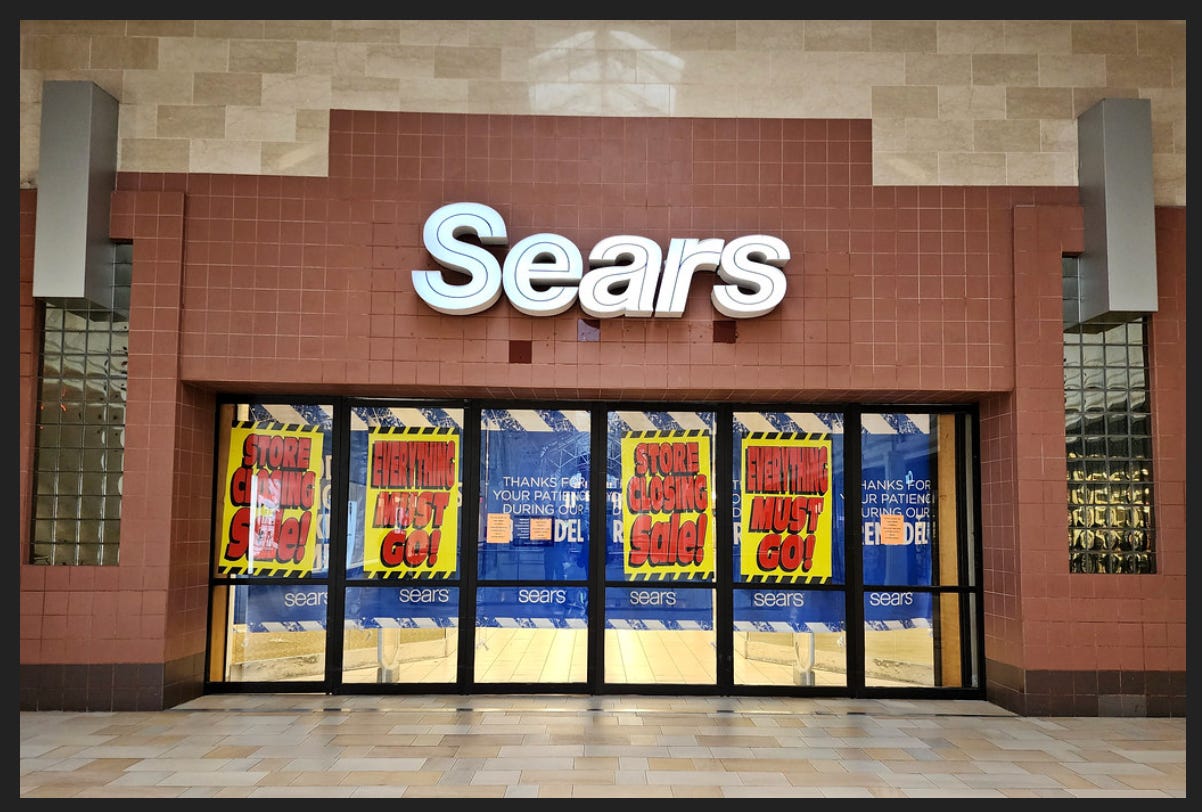
There are only five Sears stores left in the U.S. now, the New York
Times reported over the weekend.1 I had all these tender feelings when I saw it, like I was watching a baby chick miscalculate distance and tumble off a ledge. Only five stores left and they’ll be gone soon enough and that will be the end of an era.
Sears was the Amazon of its day: When you needed something, that’s where you went. They had it all. The Sears outlet in Lindale, Texas is where my grandmother took me, the summer that Elvis died. She insisted on buying me a pair of Lee Wrangler jeans with pleather trim on the back pockets. I let her, even though I wouldn’t be caught dead in them in New York, where I lived. My grandfather also had a Sears connection. On the Texas farm where he grew up, his family put the Sears, Roebuck & Co. catalogue to good use in the outhouse, where it stood in for toilet paper.
The company began life in Minneapolis in 1886, when Richard W. Sears founded the R.W. Sears Watch Company to sell watches by mail order. He relocated his business to Chicago in 1887, hired Alvah C. Roebuck to repair watches, and launched a mail-order business for watches and jewelry. By offering an array of merchandise at low prices to farms and villages that had no easy access to retail outlets, the company grew explosively.
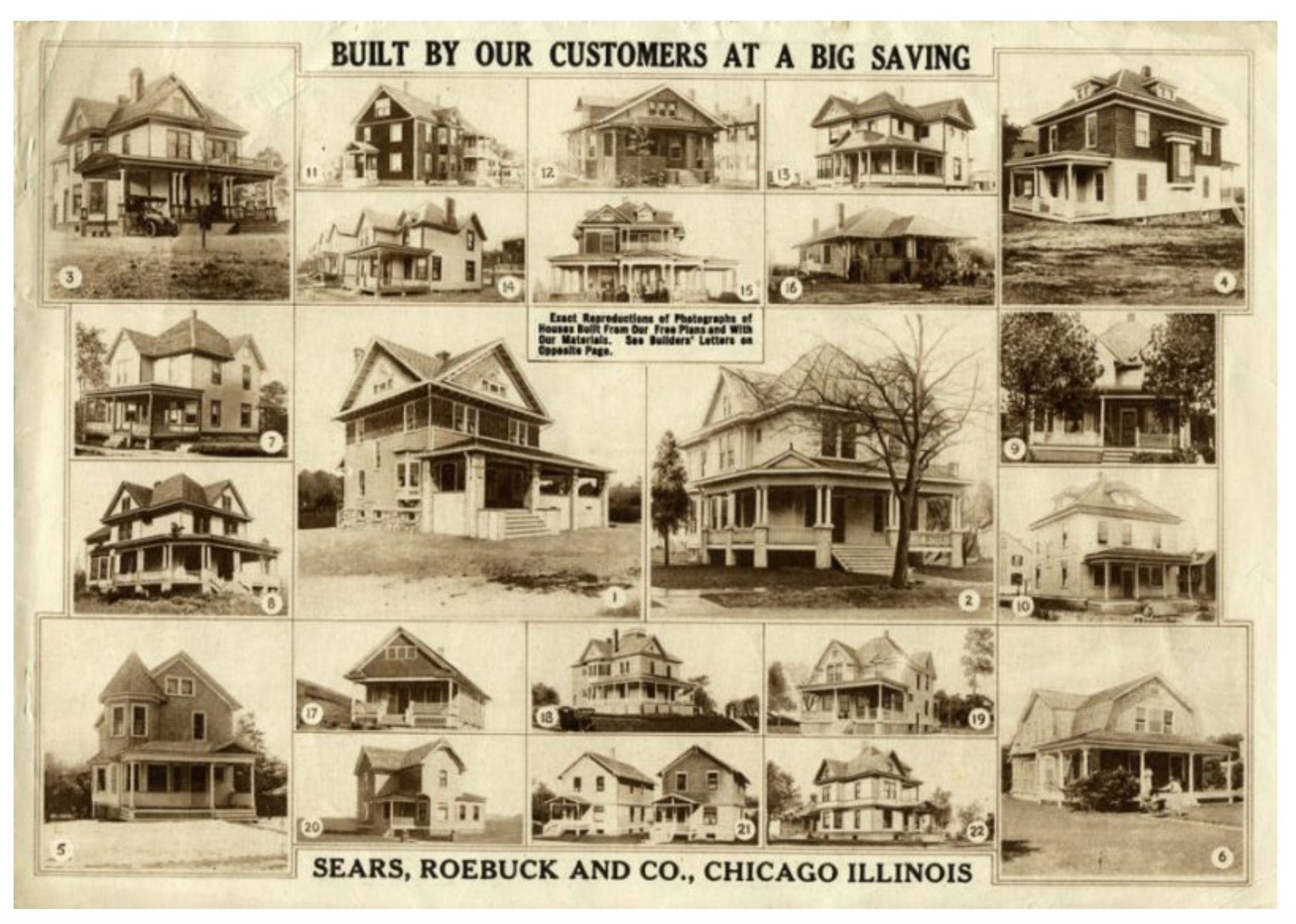
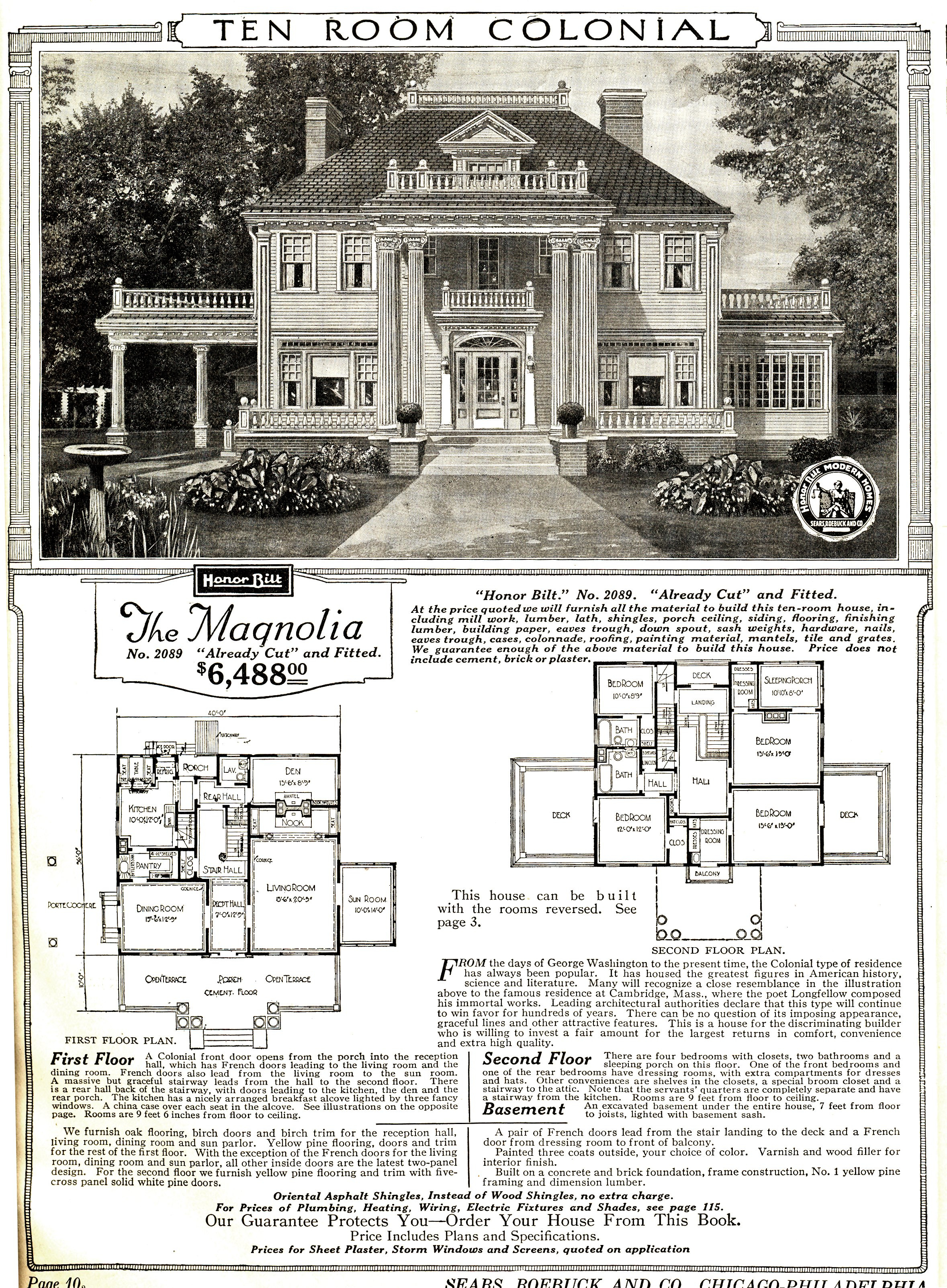
Once the automobile arrived on the scene, Sears began opening retail stores — 3,500 at its peak. It was an iconic brand. For 20-odd years, Sears owned the Encyclopædia Britannica. It created Allstate Corp. in 1931. Its house brands, like Craftsman and Kenmore, were household words. But its crowning achievement, at least to my mind, was Sears Modern Homes. Between 1908 and 1939, Sears sold some 75,000 house kits across the country, in a wide range of sizes and architectural styles from Craftsman to Cape Cods. The kits included most of the building materials for a house, shipped via railroad boxcars. I love this for its crazy ambition, its outlandishness, its Americaness. I love it.
By the time I went there with my grandmother, Sears had long since lost its lustre. It didn’t feel properly organized into sections, but jumbled and too big and it smelled like tires. I wasn’t yet a teenager, but still old enough to be embarrassed to death to be shopping there. It was not Fiorucci, I’ll put it like that. The world was moving on, it was obvious, but Sears didn’t yet know it was dying.
Sears was the uncontested king, the largest retailer in the U.S. until the ‘80s, when it was overtaken by Kmart and then by Wal-Mart. Its demise marks the end of an era because the companies that succeeded it aren’t like it. Sears did bad things, of course. All companies do. But it didn’t spy on its customers. It didn’t rack up creepy defense contracts or wield monopoly power like a bloodied axe or suck up public resources for nothing and otherwise damage communities and God knows what else. But behind the curtain, where we can’t see, our overlords appear to be planning to extract every last drop out of us, before they just let us die. We are all serfs now and soon the billionaires will longer need us.
In Sears’ day, the customer was always right. Back then — and this, as strategy, no longer even sounds credible — you sought to satisfy a customer by providing a good product at a fair price, all in the hope that the customer would come back. You didn’t try to screw them into a wall, into pulp, like companies do now. And that’s the shift: Late capitalism perceives us not as consumers, but as prey. We are captured. The wealth class took off its mask at the inauguration. We all saw them on that podium. They will keep on stripping our assets, raising prices and degrading the quality of everything until it all falls down.
Umair writes in How to Think About the Economy in 2026, “ ... that ‘affordability crisis’ is really just the flip side of capitalism doing very well: It’s exploiting people at a rate which is crushing them. But all of that spells real trouble ahead. Because of course people can’t keep up this rate of exploitation forever, or even much longer.” We are headed for a crises of demand, when this rate of exploitation spikes so high it punctures the economy like a pin in a balloon, killing growth, killing profit.
If I had stayed in the U.S., I think I would be in trouble now. I think I would be at risk of plunging out of the upper middle class, with my children falling right behind me, all in less than a generation. This is the American Nightmare, the corollary of the American Dream, and it is taboo to discuss it, for reasons I don’t understand. Still, no one I know in the U.S. can afford anything. Those diplomas aren’t pulling their weight anymore, the kids are done in by anxiety and all sense of security has disappeared, like a fist when you open your hand. A job loss doesn’t feel like a survivable event in this climate, amid this palpable dread. Where do you invest effort? How do you get ahead of this?
You don’t. We went from normal enough to here in less than a year. The speed leaves you breathless. But this isn’t a new era, like the heydays of Sears and Elvis or my Greatest Generation grandparents. Eras change almost invisibly. They wind down, you adapt to what is changing, you dig in and then, all of a sudden, the characteristics that defined the past era seem unimaginable.
My grandmother sewed her own wedding gown, cooked (and burned) bacon for breakfast every single day, and washed out my mouth with soap for taking the Lord’s name in vain. Those things all seem wildly implausible now. So does supporting a family of four in New York on one income, with two kids in private school, like my dad did. It doesn’t seem real, like shopping for jeans at Sears, or paying for a flight with cash or making a call from a phone booth with a quarter. Like smoking at the office and on planes, too. Like buying a two-bedroom condo in a doorman building in Prospect Heights, Brooklyn on a newspaper editor’s salary, like I did in the penultimate year of the previous century.
This isn’t a new era, but a new paradigm, as capitalism has begun to eat itself.
I am unable to link to the New York Times as I canceled my subscription after 30+ years, in protest of their shameful capitulation to the regime.
Sears also employed great salesmen--yes, I think mostly men--one of whom is my uncle who fortunately transitioned to be great at real estate after years of selling appliances. The slow, inevitable decline of Sears is also the story of declining person-centered customer service and potentially part of the loss of trust in each other.
This piece brings back so many memories for me. My father was in the Army so we lived on military bases and moved around a lot. But there was just about always a Sears, and that was always my mother's outlet of choice. Clothes, shoes, dishes, pots and pans, sporting goods. Their products were affordable and reliable. Even thought I knew it had been a while since I was in a Sears, but I didn't really it was actually closing. And its departure speaks so much to end of the retail outlets and spirit we've lost.