

The Frozen Hours
As the U.S. Menaces Europe, Are Expats Still Safe?

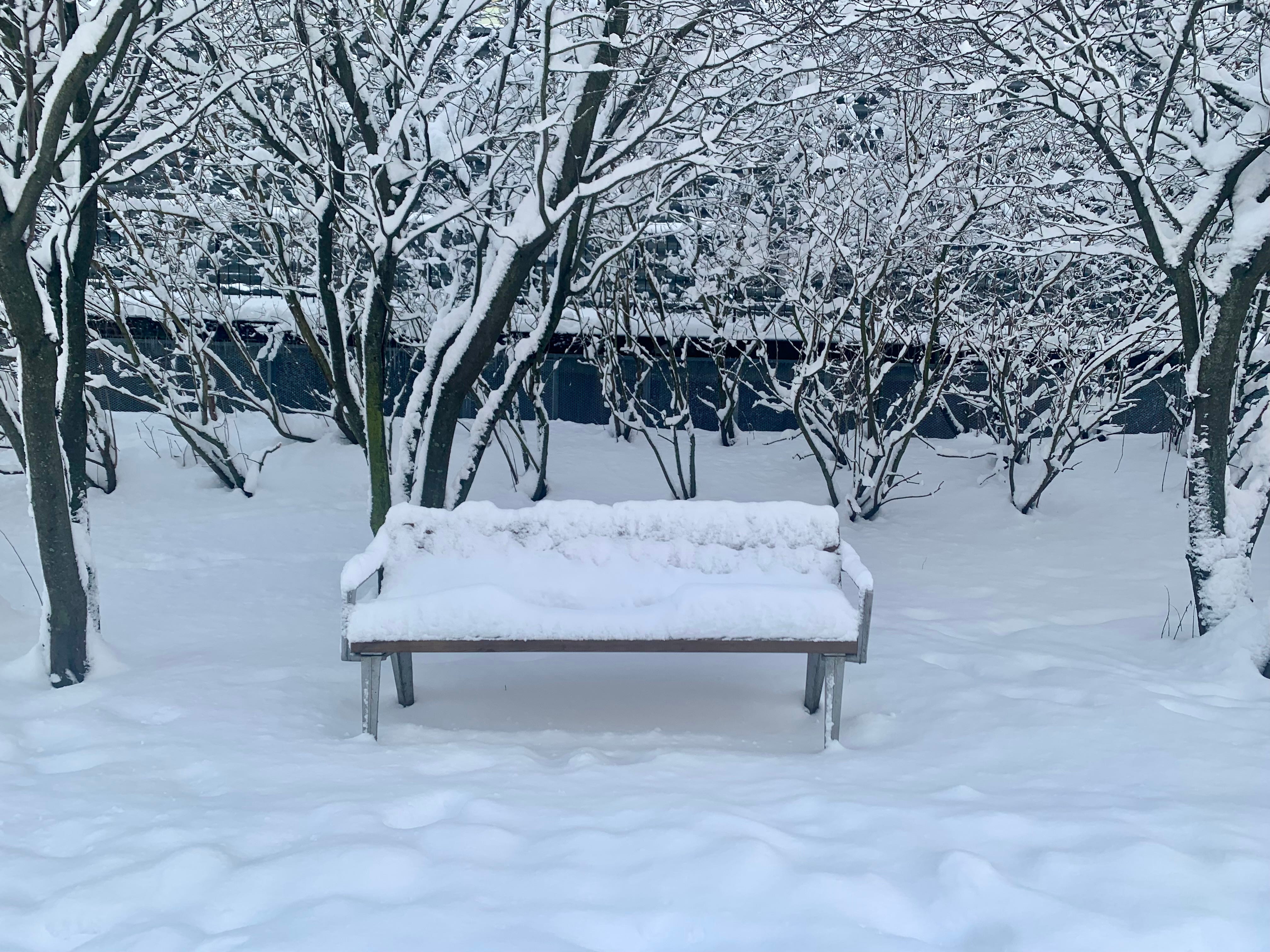
It’s the season of ice, here in a land of ice. It’s everywhere, beautiful and treacherous. In the polar night, the ice glitters in the sodium-vapor streetlights like diamond pavé. The more trafficked places have the most ice, hard packed and planed smooth. You can fracture an arm or break a hip on it in an instant, so it forces you into wariness, to choose your footing with intention. I move so tentatively outside that my eldest taunts me, calling out, “Run, Forrest, run!” I move so slowly that sometimes I feel I’m not moving at all.
Older Swedes wear cleats on their boots, tiny spikes that grip the ice. In fact, the city of Gothenberg sends them out for free to citizens when they turn 65. But Stockholm, where I live, doesn’t do that. It’s up to me to decide when I need them, but that decision would be conceding that I am old and I’m not yet.
Walking around in winter requires some technique, then, or at least it does for me. Most Swedes scamper up and down curb-side piles of glistening ice like mountain goats. They ride bikes on the ice next to huge trucks and they never slip or slide. For myself, I have to work at it. The foot must land squarely: No angles, straight down.
“Walk like a soldier,” my husband said during my first winter here. “There’s a reason armies march.”
For years now, I’ve been urging people to get out of the U.S. like I did in 2019. I wrote about my decision to leave and about why I thought life in Europe was better. I talked to what felt like a million would-be emigres about strategy and I put together a guide. I did most of this under the Biden Administration, when I thought the risk of democratic collapse was receding. I still believed at this time that all of the things that were wrong with the U.S. were somehow policy oversights, fixable gaps. I thought that if we advocated with enough passion and grit, Americans could get things like universal healthcare and rational housing markets and tuition and childcare at accessible prices. Still, I could feel something menacing slithering underneath the surface. I sensed that people were becoming devalued, as labor, as humans, as Americans. After the election, I would come to understand what that menacing thing was: A new economic dynamic of serfs vs wealth class, in which they win and we lose.
This year, I began to dread winter before summer had even ended. I knew that things in the U.S. were going to get worse and I didn’t know how to fight it. Then I woke up one day this fall with no use of my left arm. It came out of nowhere: I hadn’t injured myself or strained the muscles. The pain was 24/7 but at first, I thought that I could continue writing, just eat some ibuprofen and crack on. But I couldn’t write, not only because I had only one arm, but because the pain kiboshed my brain. I didn’t have a single idea, nothing for weeks at a time. I was unable to form associations, the raw material of ideas. For a writer, this is game over.
Probably frozen shoulder, the doctor said. To freeze is a neural response to a threat. It’s a state of attentive immobility that allows animals (that’s us, if you’re not clear) to avoid detection by predators, and to enhance perception.
We’re probably at the point where it’s too late for many Americans to leave. The whole of the EU is tightening immigration restrictions and so are many countries in Asia and Latin America. They don’t want us. We have a bad reputation, I hate to say. We’re loud and we often don’t bother to learn the local language. We don’t approach community in a way Europeans recognize. We drive up housing prices and welch off healthcare systems that we didn’t pay into. I was already hearing stories of Americans getting harassed across Europe, in the airports, on the streets. Now Europeans are furious at us and rightly so: Trump’s mad talk of annexation and invasion is threatening the whole world. We will become pariahs.
My adopted country just sent troops to defend against a threatened invasion by the country of my birth. France, Germany, Norway, Finland, the Netherlands and the UK did, as well. We are becoming despised.
Before the election, I thought Trump 1.0 was the story of a close call. I wrote a novel based on that premise, about that dark place where we almost went. I didn’t know it was a prelude.
Now we all know and that novel is in a drawer, the bleak fictional future it described eclipsed by a far worse reality. I worry about all of us who are here now. If the U.S. invades Greenland or attacks another NATO ally, Americans living or working in Europe could lose their legal protections and residency status with a stroke of a pen. The story isn’t over for all of those people who made it out, who are sitting in the sun in Portugal and Spain and Italy and France. It is not over for me. We could become persona non grata, facing deportation or even internment, as the U.S. did to Japanese Americans during World War II. We may need to scramble again.
I’m a Swedish citizen now, but they know I’m not native. Americans aren’t hard to spot. They could turn on me in heartbeat, if it came to it. I wonder if the time is coming where I will need to obfuscate my origins, perhaps impersonate a Brit or just keep my mouth shut.
Time feels frozen now. We are at “the still point of the turning world,” as T.S Eliot said. No one is stopping him. Nowhere is safe and nobody’s children, either. The cascade of consequences will probably be terrifying on a scale Americans cannot imagine. The Doomsday Clock now stands at 89 seconds to midnight, the closest to catastrophe in its nearly eight-decade history. No one is taking a breath.
If you believe, as I do, that the unconscious speaks through the body and that disease originates in part in the psyche, then what is a frozen shoulder saying? Why this now? I’ve spent so much time on the couch, my bad arm propped up on a stack of throw pillows, waiting. It has been, above all, so incredibly boring, but I think I needed it. When he blows up the world — and he will — I hope to be ready.
"Nowhere is safe now". Certainly feels like it. People in the US used to say, "I'll go to Canada" but that was never as easy as many thought. And now, what would it do for you? I'm in Canada and I asked a relative, where would we go? Realistically any place could threatened by Trump or Putin, unless we went to Asia, which culturally would be too much of a shock for this old person.
Expats may not be safe. But I would hope that those democracies which are currently home to American expats have a greater appreciation of human rights now than they may have had during World War II, when internment camps were routinely used. Those expat Americans can provide insight on what Trump and his cronies might do. We harbour no illusions whatsoever about the destruction that has been done in the US and are determined to stop the contagion from reaching our new homes.
So long as the rest of the world truly closes the door on the US through the use of trade embargoes, sanctions and the closing of overseas US bases, the united less powerful countries may yet bring the US under the Donroe Doctrine down. This is the time to reassess and recalibrate our multilateral institutions to be a collaboration among equal states who are committed to human rights and nonviolent means of solving problems; but who are not willing to back down in the face of aggression.
Trump's domestic policies are beggaring most Americans, which certainly undermines the US as a large global economic power. The imposition of severe economic and financial sanctions on US businesses could limit their ability to produce goods for domestic consumption or for export. In an interconnected world, where most of the "dirty" work and raw materials were sourced outside of the US, where recent generations of Americans are not accustomed to manual labour and where most of their goods come in on container ships operated by Danish or Chinese firms, life in the US will become awfully hard very fast. Modern weaponry depends on global supply chains which are not under US control. Without access to overseas bases, it is darned hard to be the policeman of the world.
We need to work together to address the growing global inequality ( both within our countries and among states) which erodes our democracies. In addition, we really need to quit our fossil fuel addiction and really address climate change. Ultimately, the rest of the world may need to reconsider the appropriate scale of business and economic growth in light of climate change.
We cannot afford to wait until the oligarchs see reason or they are toppled. We can stand up to aggression and can isolate them so they starve. At the same time,we just have to get on with solving the global problems that we see, even if it will not all be pleasant. But in the end, if we face the facts, and are united in our actions and uphold our values and human rights, the world will change and perhaps for the better...Two steps forward and one back.
Trump may still argue burn baby burn...But done right, global sanctions should be able to deprive him of the fuel and funds to wreck the world. He will of course continue to wreck the US, until the mobs take him down with pitchforks. At some point, Canada and the rest of the world may have to figure out how to handle American refugees, those people fleeing from war and destruction. I can only hope that we can separate the people from the oppressive government.